


Artificial intelligence is transforming the way businesses operate, serve customers, analyze information, and make strategic decisions. From AI-powered chatbots and virtual assistants to predictive analytics and automated workflows, artificial intelligence is becoming an important part of modern business technology. However, successfully implementing AI requires more than simply purchasing an AI tool. Businesses often need customized software, reliable data, skilled developers, secure infrastructure, and continuous technical support.
This is where artificial intelligence development services become valuable. These services help organizations plan, develop, integrate, deploy, and maintain AI-powered applications designed around specific business requirements. Whether a company wants to automate repetitive tasks, improve customer service, analyze large datasets, or launch a new AI-powered product, professional development services can provide the technical expertise required to turn an idea into a working solution.
What Are Artificial Intelligence Development Services?
Artificial intelligence development services are professional technology services focused on creating software applications that use AI to perform tasks that traditionally require human intelligence. These tasks can include understanding natural language, identifying patterns, analyzing images, making predictions, generating content, and supporting business decisions.
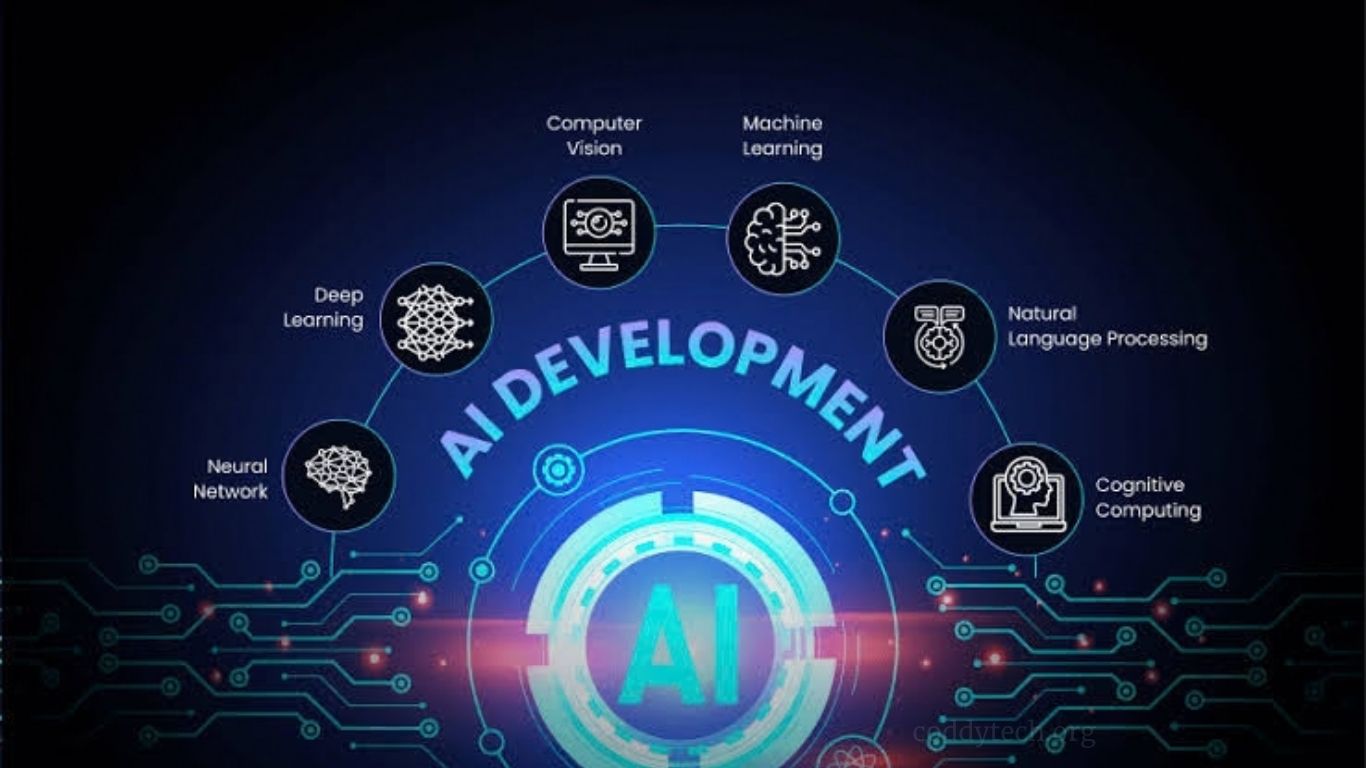
AI development can involve several technologies, including machine learning, natural language processing, computer vision, deep learning, generative AI, predictive analytics, and intelligent automation. The technology used depends on the business problem, available data, desired functionality, and expected results.
Instead of depending entirely on generic AI software, organizations can work with an AI development team to create customized applications that connect with existing websites, mobile applications, databases, CRM platforms, enterprise software, and internal business systems.
Why Businesses Need AI Development Services
Businesses generate and process large amounts of information every day. Manually analyzing this information or completing repetitive tasks can consume significant amounts of time and resources. AI can help organizations process information faster and identify useful patterns that may be difficult to discover through traditional methods.
Professional AI development services can help companies automate routine operations, improve employee productivity, enhance customer experiences, and support data-driven decision-making. AI can also help organizations personalize their services and respond to customers more efficiently.For companies operating in competitive digital markets, a properly designed AI solution can improve operational efficiency while creating new opportunities for products, services, and revenue.
Read More: Fashion Tech News
Custom AI Software Development
Custom AI software development involves creating an intelligent application specifically for a company’s requirements. Instead of using a generic solution with limited customization, developers analyze the organization’s business processes and build features around its specific goals.
A custom AI application may include intelligent search, automated document processing, predictive features, personalized recommendations, automated decision support, or AI-powered customer assistance. Custom development can also allow the application to integrate with existing business systems, making it easier to incorporate AI into established workflows.
Machine Learning Development Services
Machine learning is one of the most widely used areas of artificial intelligence. It allows software to learn patterns from data and use those patterns to make predictions or classifications.
Machine learning development services can be used for demand forecasting, fraud detection, customer segmentation, recommendation systems, predictive maintenance, risk analysis, and other applications. Developers typically work with data preparation, model development, training, evaluation, deployment, and monitoring to ensure the system continues to perform effectively.
Generative AI Development Services
Generative AI can create new content such as text, images, code, summaries, and other digital outputs based on user instructions or available information. Its rapid development has created new opportunities for businesses across many industries.
Generative AI development services can help organizations build AI assistants, content-generation platforms, document analysis tools, internal knowledge systems, and customer-facing applications. Developers can integrate suitable AI models with business data and software while adding appropriate security, access controls, and monitoring.
AI Chatbot Development
AI chatbots allow businesses to communicate with customers through natural language. Modern AI-powered chatbots can understand questions, maintain context, and provide relevant responses across a wide range of customer-service scenarios.
Companies can use AI chatbots for answering frequently asked questions, helping customers find products, qualifying leads, providing basic technical assistance, managing appointments, and supporting employees. When properly integrated with business systems, chatbots can provide faster assistance while reducing the workload on human support teams.
Natural Language Processing Development
Natural language processing, commonly known as NLP, allows computers to understand, analyze, and generate human language. NLP technology can process written or spoken information and convert it into useful business insights or automated actions.
Businesses can use NLP for sentiment analysis, text classification, document summarization, intelligent search, language translation, voice assistants, customer feedback analysis, and automated document processing. NLP is particularly valuable for organizations that handle large amounts of text-based information.
Computer Vision Development
Computer vision enables software to understand and analyze images and video. It is increasingly being used in industries such as manufacturing, retail, healthcare, logistics, agriculture, and security.
Computer vision solutions can identify objects, classify images, analyze documents, inspect products, monitor processes, and support visual search. In manufacturing, for example, computer vision can help identify defects during production, while retailers can use visual technology to improve product discovery.
Benefits of Artificial Intelligence Development Services
Improved Business Automation
AI can automate repetitive business processes that previously required significant manual effort. Tasks such as document classification, customer inquiries, data processing, report generation, and workflow management can often be partially or fully automated.This allows employees to spend more time on strategic, creative, and customer-focused responsibilities instead of repeatedly performing routine tasks.
Better Customer Experience
AI can help businesses provide faster and more personalized customer experiences. Intelligent systems can respond to common questions, recommend relevant products, analyze customer preferences, and provide support beyond traditional business hours.When AI is connected with customer information and other business systems, companies can provide more consistent interactions across websites, applications, and customer-service channels.
Data-Driven Decision Making
Modern organizations collect information from websites, applications, transactions, customer interactions, and internal operations. AI can analyze large volumes of this information and identify trends, patterns, and potential risks.Predictive analytics can help companies forecast demand, understand customer behavior, identify unusual activity, and make more informed operational decisions.
Reduced Operational Costs
AI automation can reduce the amount of time employees spend on repetitive activities. Although developing an AI solution requires an initial investment, a successful system can provide long-term efficiency improvements and reduce unnecessary operational costs.
The financial benefits depend on the specific use case, implementation quality, scale of automation, and ongoing maintenance requirements.
Greater Business Scalability
AI-powered systems can be designed to support growing workloads, increasing customer numbers, and larger amounts of data. A scalable architecture allows companies to expand their AI applications without completely replacing the underlying technology.This can be particularly useful for businesses expecting rapid digital growth.
Artificial Intelligence in Healthcare
Healthcare organizations can use AI development services for medical image analysis, administrative automation, patient communication, research support, and data analysis. AI can help healthcare professionals process information more efficiently and support certain operational decisions.
However, healthcare AI requires careful consideration of accuracy, privacy, security, safety, and applicable regulations. Human oversight remains important when AI systems are involved in sensitive healthcare workflows.
Artificial Intelligence in E-Commerce and Retail
E-commerce companies can use AI to improve product recommendations, customer support, demand forecasting, inventory analysis, search functionality, and fraud detection. Personalized recommendations can help shoppers discover products that are more relevant to their interests.
AI can also analyze purchasing behavior and customer interactions, allowing retailers to better understand their audiences and improve digital shopping experiences.
Artificial Intelligence in Banking and Finance
Financial institutions can use AI for fraud detection, risk analysis, customer service, transaction monitoring, document processing, and financial forecasting. Machine learning systems can analyze large volumes of transactions to identify unusual patterns that may require additional investigation.
Because financial applications involve sensitive information and strict regulatory requirements, security, privacy, transparency, and appropriate human oversight are essential components of responsible AI development.
Artificial Intelligence in Manufacturing
Manufacturing companies can apply AI to quality control, predictive maintenance, production optimization, equipment monitoring, and supply-chain operations. Computer vision can inspect products for defects, while machine learning can analyze equipment data to identify potential maintenance issues.These applications can help manufacturers reduce downtime, improve product quality, and optimize production processes.
Artificial Intelligence in Education
Educational institutions and technology platforms can use AI to support personalized learning, automated assistance, content recommendations, language learning, and administrative workflows.AI can help students access information more quickly and provide educators with tools for managing repetitive tasks. However, AI should complement rather than completely replace teachers and educational professionals.
Artificial Intelligence in Logistics and Transportation
AI development can help logistics and transportation businesses optimize delivery routes, forecast demand, monitor operations, and improve scheduling. AI systems can analyze historical and real-time information to support more efficient transportation planning.For large logistics operations, even small improvements in route planning and resource allocation can have a meaningful impact on efficiency and operating costs.
How Artificial Intelligence Development Works
Identifying the Business Problem
A successful AI project begins by clearly defining the business problem. The organization needs to determine what it wants to improve, whether the objective is reducing manual work, improving customer service, predicting demand, analyzing information, or developing a new product.Starting with a specific business objective helps developers select the right technology instead of using AI simply because it is popular.
Analyzing Data and Technical Requirements
Data is an essential part of many AI systems. During this stage, developers examine available datasets, data quality, privacy requirements, existing software, infrastructure, and integration requirements.The quality and relevance of the available data can significantly influence the performance of an AI application.
Selecting the Right AI Technology
The development team selects an appropriate technology based on the project requirements. A chatbot may require natural language processing and generative AI, while a manufacturing inspection system may require computer vision.Choosing the correct technology helps control development costs while improving the usefulness and reliability of the final application.
Developing and Training the AI Solution
Developers then build the application and prepare the necessary data. Depending on the project, they may train machine learning models, configure AI models, create application interfaces, and connect the solution with existing business systems.Testing is performed throughout the development process to identify technical problems and improve performance.
Testing and Evaluation
AI systems require extensive testing before being introduced into production. Developers evaluate accuracy, reliability, security, performance, usability, and the system’s ability to handle different types of input.Testing can also help identify unexpected outputs or situations where human review is necessary.
Deployment and Continuous Monitoring
Once an AI solution has passed testing, it can be deployed for users or internal teams. However, development does not necessarily end after launch.
AI systems should be monitored to identify performance changes, data-quality issues, security risks, and other problems. Continuous improvement can help maintain the system’s effectiveness as business requirements and data change.
How to Choose the Right AI Development Company
Choosing an experienced AI development company is an important step for businesses planning an AI project. Companies should evaluate a provider’s technical capabilities, previous projects, development methodology, communication process, security practices, and post-launch support.
Businesses should also determine whether the development team has experience with the technologies required for their project. Reviewing previous AI applications can provide insight into the provider’s ability to deliver practical solutions.A strong development partner should focus on understanding the business objective rather than simply recommending complex technology. Clear communication about timelines, costs, integrations, security, and maintenance can also reduce potential problems during development.
Cost of Artificial Intelligence Development Services
The cost of artificial intelligence development services varies depending on the scope and complexity of a project. A basic chatbot or proof-of-concept application may require a smaller investment than an enterprise AI platform involving large datasets, multiple integrations, advanced machine learning models, and extensive security requirements.
Development costs can be influenced by application complexity, data preparation, model requirements, infrastructure, third-party services, integrations, testing, security, and ongoing maintenance.Businesses should therefore define their requirements and expected outcomes before requesting a development estimate. A clear project scope makes it easier to create a realistic budget.
Challenges of AI Development
Artificial intelligence provides many opportunities, but organizations also need to consider its limitations. Poor-quality or incomplete data can negatively affect AI performance, while poorly designed systems may produce inaccurate or inconsistent results.
Data privacy and cybersecurity are also important considerations, particularly when AI applications process customer information, financial records, business documents, or other sensitive data. Organizations should establish suitable security controls and data-management practices.Another challenge is ongoing maintenance. AI models and business requirements can change over time, making monitoring, evaluation, and periodic updates necessary.
Future of Artificial Intelligence Development Services
The future of AI development is expected to involve increasingly capable and specialized applications. Generative AI, AI agents, multimodal systems, predictive analytics, intelligent automation, and AI-powered business software are likely to continue influencing digital transformation.
Businesses are increasingly focused on using AI to solve practical problems rather than adopting technology simply because it is new. Organizations that combine AI with high-quality data, secure infrastructure, human expertise, and responsible governance can create more sustainable AI strategies.As AI becomes more integrated into everyday business software, artificial intelligence development services will continue to play an important role in helping organizations design and implement customized solutions.
Frequently Asked Questions
What are artificial intelligence development services?
Artificial intelligence development services include the planning, design, development, integration, deployment, and maintenance of AI-powered software and applications created to solve specific business requirements.
What types of AI applications can businesses develop?
Businesses can develop AI chatbots, virtual assistants, recommendation systems, predictive analytics platforms, machine learning applications, computer vision software, NLP solutions, generative AI tools, and intelligent automation systems.
How much do AI development services cost?
The cost depends on factors such as project complexity, data requirements, integrations, infrastructure, security, development time, and ongoing maintenance. Simple AI applications generally cost less than complex enterprise solutions.
How long does AI development take?
The development timeline depends on the project’s scope. A basic proof of concept may take considerably less time than a production-ready enterprise AI system requiring extensive data preparation, integrations, testing, and security.
Why should a business invest in custom AI development?
Custom AI development allows a company to create a solution around its specific processes, data, customers, and objectives. It can provide greater flexibility and integration compared with relying entirely on generic AI software.
Is AI development suitable for small businesses?
Yes. Small businesses can use AI for customer support, content workflows, data analysis, lead management, automation, and other tasks. The best approach is usually to begin with a clearly defined problem where AI can provide measurable value.
Conclusion
Artificial intelligence development services help businesses transform AI concepts into practical software solutions. From custom AI applications and machine learning systems to chatbots, generative AI, natural language processing, and computer vision, businesses can use different AI technologies to improve automation, customer experience, decision-making, and operational efficiency.
The most successful AI projects begin with a clear business problem and use technology that directly supports the desired outcome. Businesses should also consider data quality, security, scalability, testing, and ongoing maintenance when developing an AI solution.With the right development strategy and technical expertise, artificial intelligence can become more than an experimental technology. It can become a valuable part of a company’s long-term digital transformation and growth strategy.

1 Comment
Pingback: Cybersecurity Analyst: Role, Skills, Career Path and How to Become One