


Functional programming is a programming paradigm that focuses on using functions to build predictable, reusable, and maintainable software. Unlike traditional programming approaches that often depend on changing variables and program states, functional programming emphasizes pure functions, immutable data, function composition, and predictable results.
As modern applications become increasingly complex, developers need programming approaches that make software easier to test, debug, maintain, and scale. Functional programming is particularly useful in web development, data processing, cloud computing, artificial intelligence, and concurrent applications.This guide explains functional programming, its core principles, benefits, challenges, popular languages, and real-world applications.
What Is Functional Programming?
Functional programming is a programming paradigm in which programs are designed primarily around functions. A function receives input, performs an operation, and produces an output without unnecessarily modifying information outside its scope.
The main goal of functional programming is to make software behavior more predictable. Instead of relying heavily on changing variables and shared states, developers create functions that perform specific tasks and return predictable results.Functional programming has its roots in mathematics and lambda calculus. Today, its concepts are used in dedicated functional languages as well as popular programming languages such as JavaScript, Python, Java, C#, and Kotlin.
How Does Functional Programming Work?
Functional programming treats functions as important building blocks of software. Functions can be stored in variables, passed as arguments to other functions, returned from other functions, and combined to create more complex operations.
For example, JavaScript allows developers to transform data using functional methods such as map():
const numbers = [1, 2, 3, 4];
const doubled = numbers.map(number => number * 2);
console.log(doubled);
The map() method creates a new array containing transformed values instead of directly changing the original array. This type of approach makes data transformations easier to understand and maintain.
Core Principles of Functional Programming
Pure Functions
Pure functions are one of the most important concepts in functional programming. A pure function produces the same output whenever it receives the same input and does not modify external data.
For example, a function that adds two numbers is considered pure when its result depends only on the values supplied to it. Because pure functions behave predictably, they are easier to test, reuse, debug, and maintain.Pure functions also reduce unexpected interactions between different parts of an application. Developers can examine the function independently without needing to understand unrelated application states.
Immutability
Immutability means that existing data is not directly changed after it has been created. Instead, when information needs to be modified, a new version of the data is generally created.
For example, rather than changing an existing array, developers can use methods such as map(), filter(), or reduce() to generate new results. This approach can reduce accidental data changes and make applications easier to reason about.
Immutability becomes especially useful in large applications where multiple components may use the same information.
First-Class Functions
Functional programming treats functions as first-class values. This means a function can be stored in a variable, passed as an argument to another function, or returned from another function.
This feature gives developers considerable flexibility when designing reusable software. Instead of hard-coding every operation, developers can create functions that accept other functions and perform different tasks depending on the supplied behavior.
Higher-Order Functions
Higher-order functions are functions that accept another function as an argument, return a function, or perform both operations. They are commonly used in functional programming to create flexible and reusable code.
Methods such as map(), filter(), and reduce() are common examples. A developer can provide a function that determines how each value should be processed, allowing the same higher-order function to perform different operations.
Function Composition
Function composition involves combining smaller functions to create a larger operation. Instead of placing many unrelated tasks inside one large function, developers can divide a process into smaller functions and connect those functions together.
This approach can improve readability and reusability because each function has a specific responsibility. Individual functions can also be tested separately before they are combined into a larger workflow.
Referential Transparency
Referential transparency means that an expression can be replaced by its resulting value without changing the behavior of a program. Pure functions support this principle because their results depend only on their inputs.
This makes software easier to analyze because developers can predict what a particular expression will produce. Referential transparency can therefore simplify debugging, testing, and reasoning about complex programs.
Functional Programming vs Imperative Programming
Functional programming and imperative programming approach software development in different ways. Imperative programming generally describes how a task should be performed through a sequence of instructions, often involving variables that change over time.
Functional programming focuses more heavily on what result should be produced by applying functions to data. Instead of repeatedly changing a variable, developers may transform a collection through functions such as map(), filter(), or reduce().Modern programming languages often support multiple paradigms. As a result, developers can combine functional and imperative techniques according to the requirements of their projects.
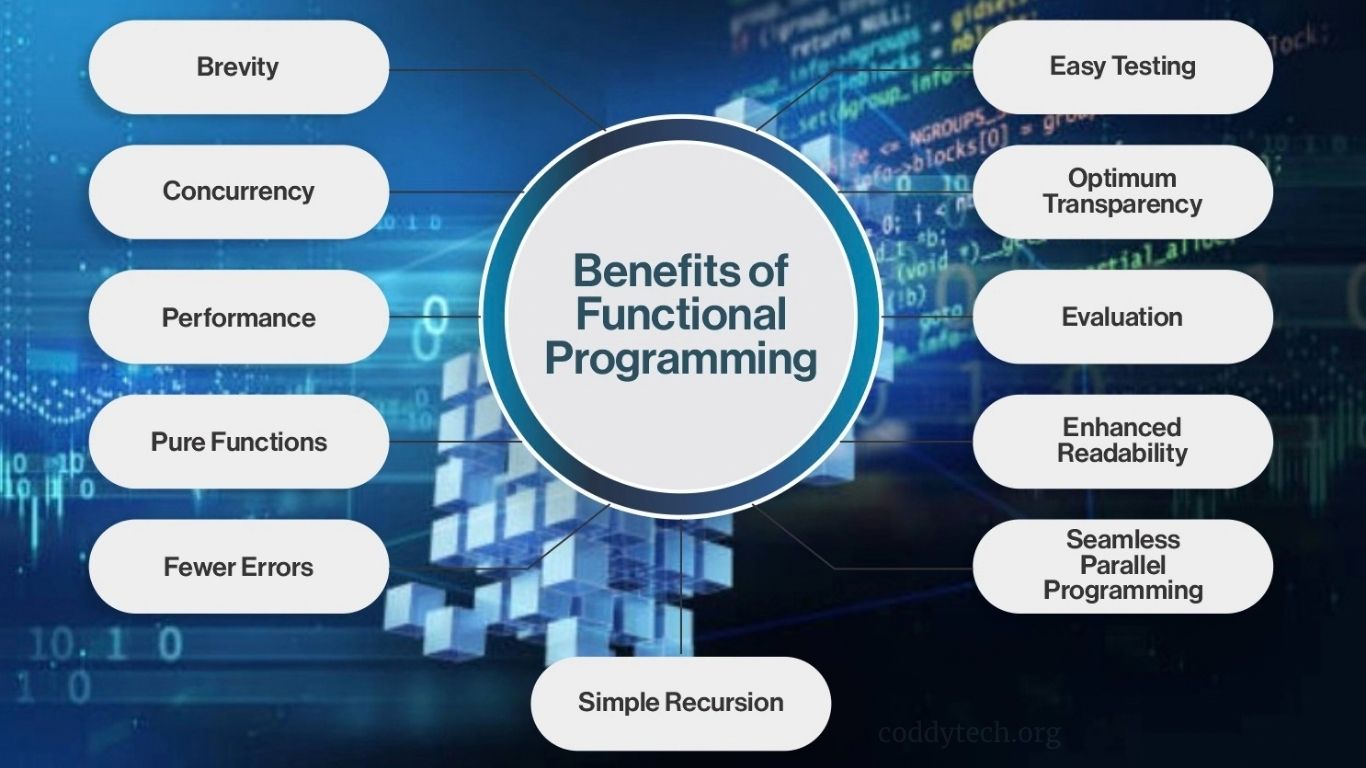
Benefits of Functional Programming
Easier Testing
Functional programming can make software testing easier because pure functions provide predictable results. Developers can provide a known input and verify the expected output without needing to recreate complicated external application states.This makes individual units of code easier to test and can help identify problems earlier during development.
Better Code Reusability
Functional programming encourages developers to create small functions that perform specific operations. These functions can often be reused throughout different parts of an application.
Instead of duplicating the same logic in several locations, developers can create a reusable function and call it whenever the operation is required. Function composition can then be used to build more advanced functionality from existing components.
Reduced Side Effects
A side effect occurs when a function changes something outside its immediate scope. Examples include modifying a global variable, changing shared data, or interacting with an external system.
Functional programming encourages developers to reduce unnecessary side effects. When functions have fewer external effects, the overall behavior of an application can become easier to understand and troubleshoot.
Improved Maintainability
Functional programming can improve maintainability by encouraging small and focused functions. When a particular operation needs to be changed, developers can often modify the relevant function without affecting unrelated parts of the application.This approach can be particularly useful in large software projects where many developers work on the same codebase.
Support for Concurrent Programming
Immutability and reduced shared state can be useful when building concurrent applications. When multiple processes or threads need to work with the same information, avoiding unnecessary modifications can reduce certain types of conflicts.For this reason, functional programming concepts are often associated with systems that require concurrent or parallel processing.
Disadvantages of Functional Programming
Learning Curve
Developers who are familiar primarily with imperative programming may initially find functional programming difficult. Concepts such as recursion, closures, higher-order functions, immutability, and function composition can require a different way of thinking.Learning these concepts gradually through practical examples can make the transition easier.
Performance Considerations
Creating new data structures instead of modifying existing ones can sometimes require additional memory or processing. Modern programming languages and runtime environments provide various optimizations, but developers should still consider performance when working with large datasets or resource-intensive applications.The appropriate approach depends on the specific requirements of the software.
Potential Complexity
Functional programming can become difficult to understand when developers use excessive abstraction, deeply nested functions, or complicated function compositions.
The goal should not be to use functional techniques everywhere. Instead, developers should choose the approach that makes the code clear, maintainable, and appropriate for the problem being solved.
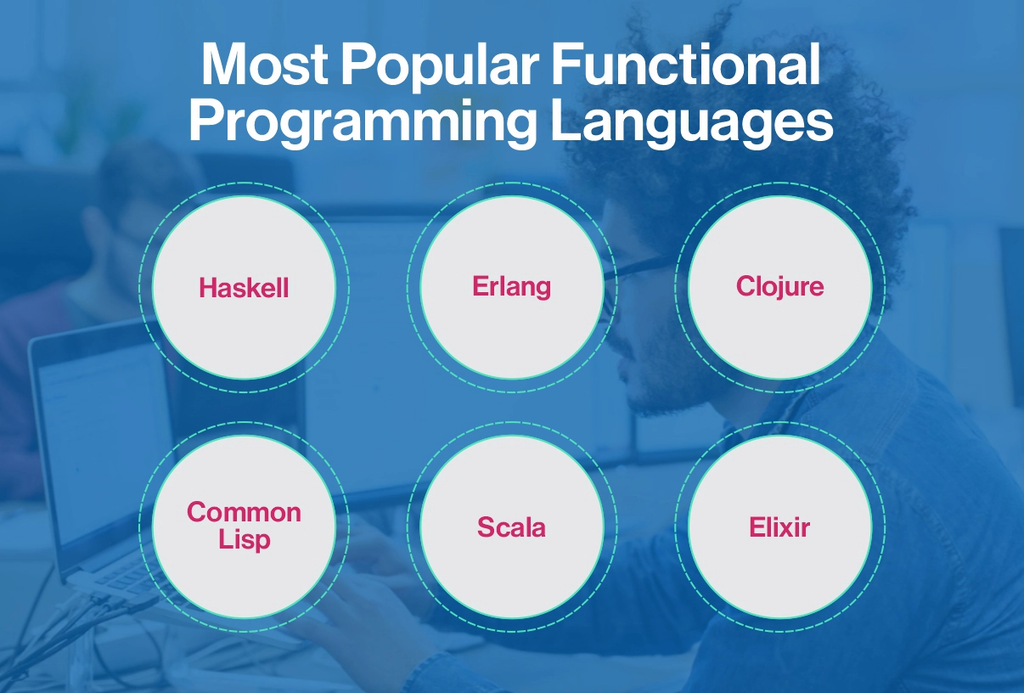
Popular Functional Programming Languages
Haskell
Haskell is a well-known functional programming language recognized for its strong static type system and emphasis on pure functional programming. It is widely studied in computer science and is also used for specialized software development and research.
Lisp
Lisp is one of the oldest programming language families and has had a major influence on functional programming. Its flexible syntax and support for symbolic processing have made it an important language family in computer science.
Clojure
Clojure is a modern Lisp dialect that runs primarily on the Java Virtual Machine. It emphasizes immutable data, functional programming, and concurrency, making it useful for applications that need reliable data processing.
Erlang
Erlang was designed for highly concurrent and fault-tolerant systems. It has historically been associated with telecommunications and distributed applications where reliability and continuous availability are important.
F#
F# is a functional-first language that operates within the .NET ecosystem. It supports functional programming while also allowing developers to access the broader .NET platform and its libraries.
JavaScript
JavaScript is not a purely functional programming language, but it provides many features that support functional programming. Functions are first-class values, while methods such as map(), filter(), and reduce() allow developers to process data using functional techniques.
Functional Programming in JavaScript
JavaScript is a popular language for learning and applying functional programming because functions can be assigned to variables, passed to other functions, and returned from functions.
For example, the reduce() method can calculate a total from an array:
const prices = [10, 20, 30, 40];
const total = prices.reduce((sum, price) => sum + price, 0);
console.log(total);
The reduce() method processes the values and produces a single result. This style can make certain data-processing operations concise and easier to express.
JavaScript developers do not need to completely rewrite their applications to use functional programming. Functional techniques can gradually be introduced into existing projects.
Functional Programming in Python
Python is another popular language that supports functional programming concepts. Functions can be assigned to variables, passed as arguments, and returned from other functions.
Python also provides tools such as map(), filter(), lambda expressions, and functools.reduce() for functional-style programming.However, Python is a multi-paradigm language. Developers commonly combine functional, object-oriented, and procedural programming techniques depending on the needs of their applications.
Real-World Applications of Functional Programming
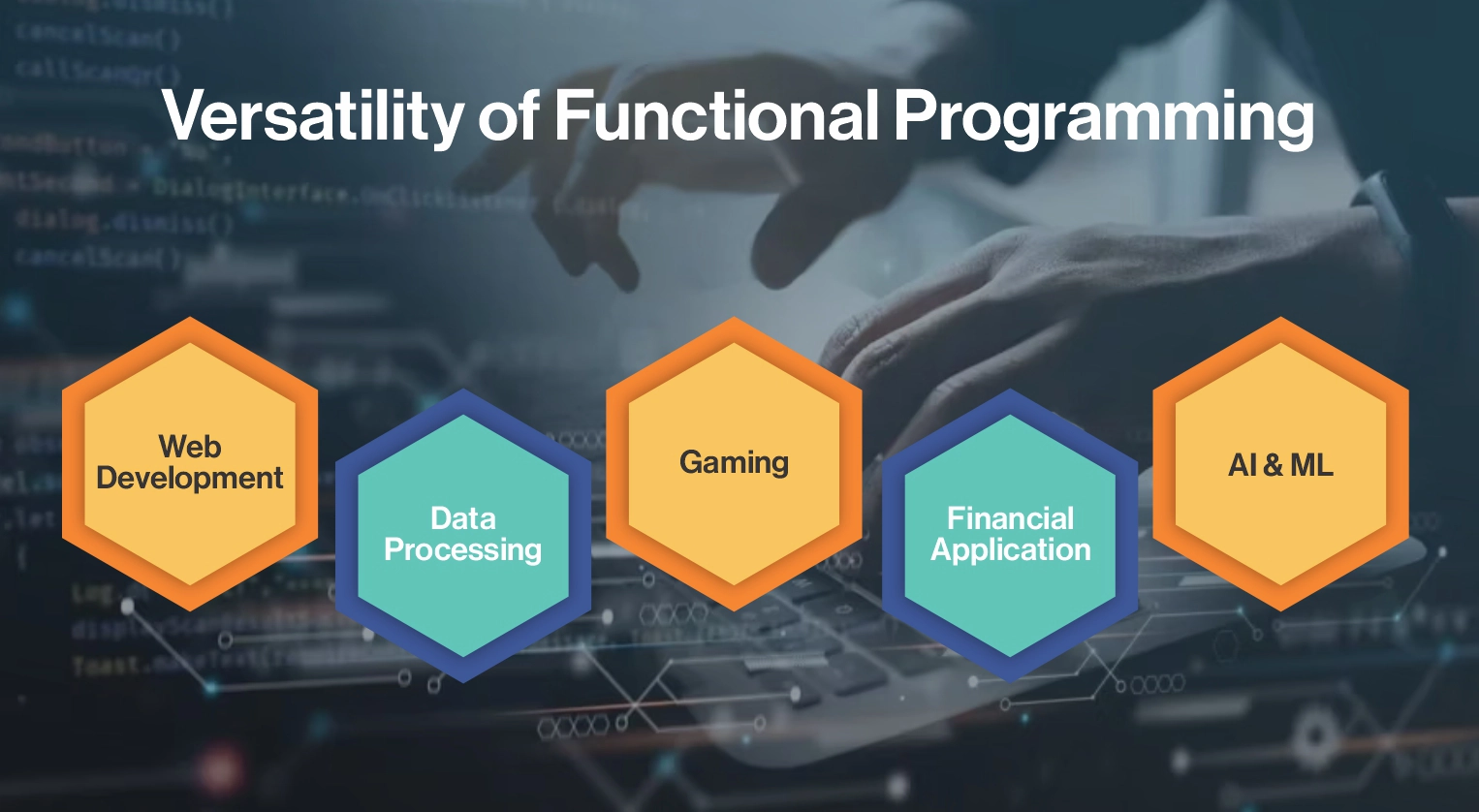
Data Processing
Functional programming is useful for processing collections and large amounts of information. Tasks such as filtering records, transforming data, calculating values, and combining results can be represented through functional operations.
This makes functional techniques useful in data-processing pipelines and applications where information passes through multiple transformation stages.
Web Development
Functional programming concepts are widely applicable to web development. Developers can use pure functions and immutable data structures to make application logic more predictable.Frontend applications can particularly benefit from predictable data transformations because modern interfaces often involve frequent state and data changes.
Artificial Intelligence and Machine Learning
Artificial intelligence and machine learning applications require significant amounts of data preparation and transformation. Functional techniques can help developers organize processing pipelines where data moves through a sequence of transformations.Pure functions can also make individual processing operations easier to test independently.
Distributed Systems
Distributed systems often involve multiple processes working at the same time. Functional programming concepts such as immutability and reduced shared state can help developers design predictable operations for distributed environments.Languages such as Erlang and functional programming techniques in other languages have been used in systems where concurrency and reliability are important.
Financial Software
Financial applications frequently perform calculations involving transactions, prices, balances, and other numerical information. Pure functions can make individual calculations easier to test and verify because the same inputs can consistently produce the same outputs.Functional techniques can therefore be useful for organizing calculation-heavy software.
How to Learn Functional Programming
The easiest way to learn functional programming is to start with basic concepts and gradually move toward advanced techniques. Beginners should first understand functions and then practice pure functions, immutable data, higher-order functions, closures, function composition, recursion, and data transformation.
JavaScript and Python are accessible starting points because both languages are widely used and provide functional programming features. Developers who want to explore a more strongly functional approach can later study languages such as Haskell, Clojure, or F#.Practical projects are especially useful for developing functional programming skills. A beginner could create a small application that filters records, transforms data, calculates totals, or processes user information using separate reusable functions.
Read more: Functional Programming
Frequently Asked Questions
What is functional programming?
Functional programming is a programming paradigm that focuses on using functions, immutable data, predictable results, and reduced side effects to build reliable and maintainable software.
What are the main principles of functional programming?
The main principles include pure functions, immutability, first-class functions, higher-order functions, function composition, and referential transparency.
What are pure functions in functional programming?
A pure function produces the same output whenever it receives the same input and does not modify external data or create unexpected side effects.
Is JavaScript a functional programming language?
JavaScript is a multi-paradigm language rather than a purely functional language. However, it supports many functional programming features, including higher-order functions, closures, map(), filter(), and reduce().
Is Python suitable for functional programming?
Yes. Python supports functional programming through first-class functions, lambda expressions, map(), filter(), reduce(), and other functional programming features.
Conclusion
Functional programming is a programming paradigm that emphasizes functions, predictable behavior, immutable data, and reduced side effects. Important concepts include pure functions, higher-order functions, first-class functions, function composition, and referential transparency.When used appropriately, functional programming can help improve code organization, testing, reusability, and maintainability. However, developers should also consider its learning curve, potential performance considerations, and the complexity that can result from excessive abstraction.
Functional programming does not require developers to abandon imperative or object-oriented programming. Modern languages such as JavaScript, Python, Java, C#, and Kotlin allow developers to combine different programming styles. Understanding functional programming therefore provides developers with another valuable approach for building reliable, scalable, and maintainable software.

1 Comment
Pingback: Custom Web Development Services: Build Your Business Website