


Custom web application development is the process of designing, building, and maintaining web-based software tailored to the specific needs of a business or organization. Unlike ready-made software, a custom web application is developed according to unique business requirements, operational workflows, customer expectations, and long-term objectives.
In today’s digital world, businesses need reliable and flexible technology to remain competitive. From customer portals and online booking systems to inventory management platforms and enterprise applications, custom web solutions help organizations automate tasks, improve productivity, and deliver better user experiences.
As businesses grow, their software requirements often become more complex. Standard applications may not provide the flexibility, security, or specialized functionality they need. Custom web application development addresses these challenges by creating solutions that align with existing processes and support future growth.
This guide explains what custom web application development is, its benefits, the development process, essential features, common technologies, and factors that influence development costs.
What Is Custom Web Application Development?
Custom web application development involves creating an application that runs through a web browser and performs specific functions for its intended users. These applications can be accessed through desktop computers, laptops, tablets, and smartphones, depending on their design and technical requirements.
Examples include customer relationship management systems, employee management portals, online learning platforms, healthcare appointment systems, e-commerce dashboards, and business reporting tools.
For example, a retail company may require an application that manages products, tracks inventory, processes orders, and generates sales reports. Instead of relying on several disconnected tools, the company can invest in a custom web application that combines these functions within a single platform.
The main objective is to develop software that solves real business problems while remaining easy to use, secure, scalable, and maintainable.
Custom Web Applications vs. Ready-Made Software
Ready-made software is designed for a broad audience and usually offers standard features that meet common requirements. Custom web applications, on the other hand, are built around the specific needs of an individual business.
Ready-made software can be suitable for companies that need basic functionality quickly and have limited budgets. However, it may include unnecessary features, lack specialized workflows, or require businesses to change their existing processes.
Custom web applications provide greater control over functionality, interface design, integrations, and future improvements. Businesses can prioritize the features they need and expand the application as their operations evolve.
Although custom development may require a higher initial investment, it can offer long-term value when the application addresses important operational challenges and reduces dependence on multiple software subscriptions.
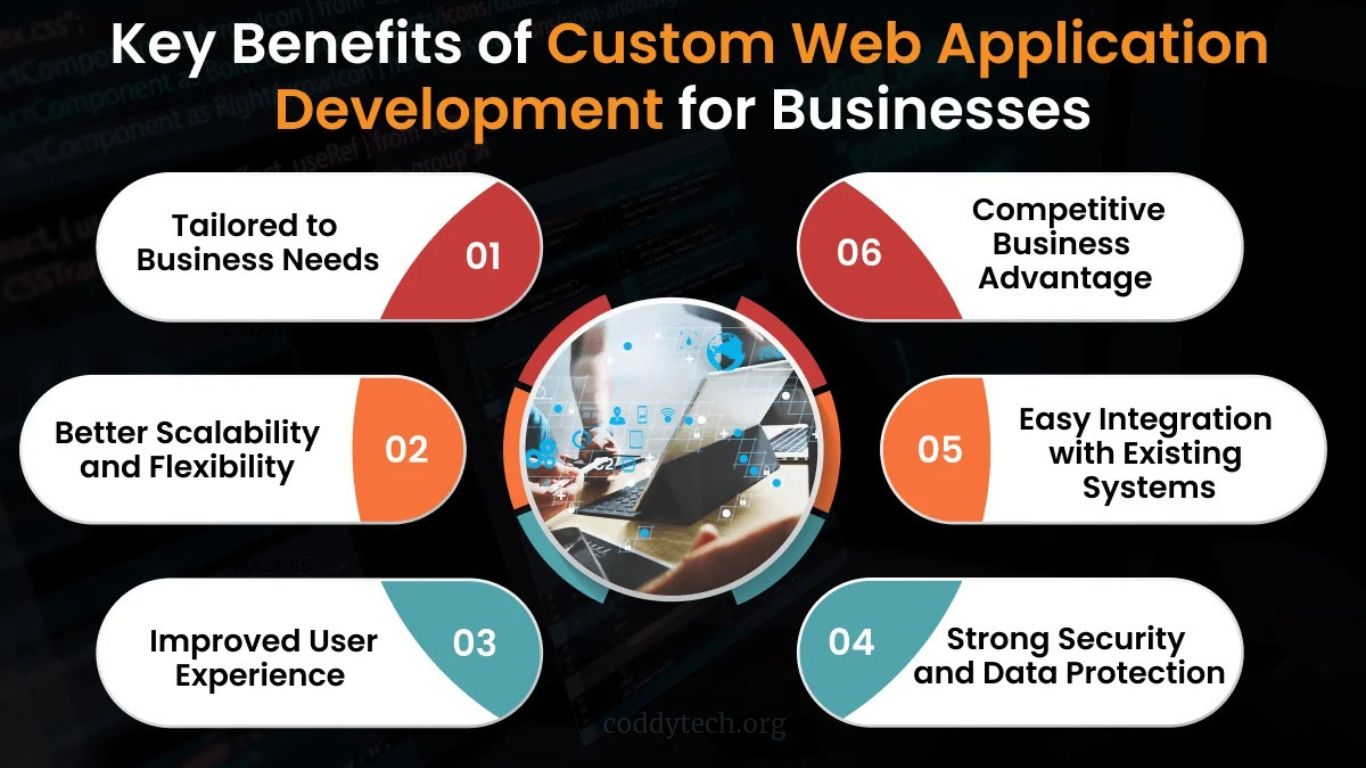
Key Benefits of Custom Web Application Development
Tailored Business Functionality
One of the biggest advantages of custom web application development is the ability to create software that matches specific business requirements. Developers can build features around existing workflows instead of forcing employees to adapt to the limitations of generic software.
A logistics company, for instance, may need shipment tracking, delivery scheduling, route management, and automated notifications. A custom application can combine these functions into a centralized system, making daily operations easier to manage.
Improved Productivity and Automation
Manual tasks can consume significant time and increase the risk of human error. Custom web applications help automate repetitive activities such as data entry, invoice generation, report preparation, order processing, and customer notifications.
Automation allows employees to focus on higher-value responsibilities instead of performing the same administrative tasks repeatedly. It can also improve consistency and help businesses complete work more efficiently.
Scalability and Flexibility
Business needs change over time. A small company may initially require a basic customer portal but later need advanced reporting, payment integrations, or additional user roles.
Custom web applications can be designed with future expansion in mind. Developers can use modular architecture, suitable databases, and scalable infrastructure to support growing traffic, larger datasets, and additional features.
Scalability depends on the application’s architecture and hosting environment, so it is important to consider future requirements during the planning stage.
Better Security and Access Control
Security is essential when applications handle customer information, financial records, employee data, or confidential business documents.
A custom web application can include role-based access control, secure authentication, data encryption, input validation, audit logs, and other appropriate security measures. Developers can tailor these protections to the application’s risk profile and compliance requirements.
However, custom software is not automatically more secure than ready-made software. Regular updates, security testing, monitoring, and responsible development practices are necessary to protect the application over time.
Seamless Third-Party Integrations
Businesses frequently use different tools for payments, marketing, accounting, customer support, analytics, and communication. Managing these systems separately can create unnecessary complexity.
Custom web application development allows businesses to connect compatible third-party services through APIs and other integration methods. For example, an online store may connect its application to a payment gateway, inventory platform, shipping provider, and customer relationship management system.
These integrations can reduce duplicate data entry, improve information sharing, and create a more connected business environment.
Enhanced User Experience
An application should be easy to navigate, responsive, and designed around the needs of its users. Custom development gives businesses greater control over the layout, navigation, forms, dashboards, and overall user journey.
A well-designed interface helps users complete tasks with fewer steps and less confusion. Responsive design also allows the application to adapt to different screen sizes.
Usability testing, accessibility considerations, and feedback from real users can further improve the experience.
The Custom Web Application Development Process
Successful development requires careful planning, technical expertise, collaboration, and ongoing evaluation. Although the exact process varies by project, most custom web applications follow several important stages.
Requirement Analysis and Planning
The first stage is understanding the business problem the application must solve. Developers and stakeholders identify the target audience, business objectives, required features, technical constraints, and expected outcomes.
The team may prepare a project scope, feature list, user stories, budget estimate, and development timeline. Prioritizing essential features helps prevent unnecessary complexity and keeps the project focused.
Clear requirements also reduce misunderstandings during development and help the team measure progress against agreed objectives.
UI and UX Design
User interface (UI) and user experience (UX) design determine how the application looks and how users interact with it.
Designers typically create wireframes, prototypes, navigation structures, and interface layouts before full development begins. These designs help stakeholders review the application and identify usability problems early.
A strong design should prioritize clarity, consistency, accessibility, and responsive behavior across supported devices.
Technology Selection
Choosing the right technology stack is an important decision. The selection depends on the application’s complexity, performance requirements, integrations, development budget, and long-term maintenance needs.
Frontend technologies such as HTML, CSS, JavaScript, and frameworks like React or Vue.js can support interactive user interfaces. Backend technologies may include Node.js, Python, PHP, Java, or .NET. Database options can include PostgreSQL, MySQL, and MongoDB, depending on the data model and application requirements.
The best technology is not necessarily the newest one. It is the technology that reliably supports the project’s requirements and can be maintained by an appropriately skilled team.
Application Development
During development, programmers build the frontend, backend, database structure, APIs, and business logic. The frontend manages the user-facing experience, while the backend handles application rules, data processing, authentication, and communication with other systems.
Developers often work in smaller iterations, delivering and reviewing features incrementally. This approach helps stakeholders provide feedback before the entire application is completed.
Version control, code reviews, documentation, and consistent coding standards also contribute to a more maintainable application.
Testing and Quality Assurance
Testing helps identify problems before the application becomes available to users. Depending on the project, this stage may include functional testing, integration testing, usability testing, performance testing, browser compatibility checks, and security assessments.
Developers should verify that important workflows operate correctly and that errors are handled appropriately. Testing should also cover different user roles, invalid inputs, and unusual situations. Fixing problems before launch can reduce disruptions and improve user confidence.
Deployment and Launch
Once the application has passed the necessary checks, it can be deployed to a production environment. This may involve configuring hosting, domain settings, databases, backups, monitoring, and security controls.
The team should verify that the live application works as expected and that appropriate recovery procedures are available. A gradual rollout may be useful for applications with large user bases or complex operational requirements.
Maintenance and Continuous Improvement
Web application development does not end at launch. Applications need regular maintenance to address software updates, security vulnerabilities, performance issues, and changing business requirements.
Monitoring helps teams identify errors, slow response times, and unusual activity. User feedback and application analytics can reveal opportunities to improve functionality and usability. A planned maintenance process helps keep the application reliable and relevant as the business evolves.
Essential Features of a Modern Web Application
User Authentication and Authorization
Secure login systems help verify user identities, while authorization controls determine which information and features each user can access. Businesses may also require multi-factor authentication and account recovery options to protect user accounts and sensitive information.
Responsive Interface
A responsive interface adapts to supported screen sizes and helps users access the application from different devices without unnecessary scrolling or navigation difficulties. A consistent experience across desktop and mobile devices can improve usability and customer satisfaction.
Admin Dashboard
An administrative dashboard allows authorized staff to manage users, monitor activity, review reports, update content, and configure application settings from a central location. A well-organized dashboard can simplify daily management and improve operational visibility.
Database Management
A properly designed database stores and organizes information efficiently. Data validation, access controls, backup procedures, and appropriate indexing help maintain data quality and application performance. Database design should reflect the application’s actual data relationships and expected workload.
Search and Reporting
Search filters, dashboards, and reporting tools help users find information and understand important business metrics. For example, an e-commerce application may provide sales reports, inventory summaries, and order status information to help managers make informed decisions.
Notifications and Integrations
Email notifications, in-app alerts, and compatible third-party integrations can improve communication and reduce manual work. Notification settings should be useful rather than overwhelming, while integrations should be tested to ensure reliable data exchange between connected systems.
Performance and Accessibility
Fast loading times, efficient database queries, accessible navigation, readable text, and keyboard support contribute to a better user experience. Performance should be tested under realistic conditions rather than assumed from development environments. Accessibility should also be considered throughout the design and development process.
Read More: Tech Industry News
How Much Does Custom Web Application Development Cost?
The cost of custom web application development varies according to the project’s size, complexity, features, technology choices, and development team’s location and experience.
A relatively simple application with basic user accounts and a limited number of workflows generally costs less than a complex enterprise platform with multiple integrations, advanced permissions, analytics, and high-availability requirements.
Important cost factors include the number of screens, complexity of business logic, database design, security requirements, third-party services, testing needs, and ongoing support arrangements. A project requiring specialized integrations or strict compliance controls may need additional planning and development time.
Businesses should also account for hosting, domain registration, monitoring, software licenses, maintenance, and future improvements. The initial development quote may not include every recurring expense.
To manage costs, organizations can begin with a minimum viable product (MVP). An MVP includes the essential features needed to validate the concept and gather user feedback. Additional features can be introduced after the application demonstrates value.
Obtaining a detailed proposal with deliverables, milestones, exclusions, and maintenance terms makes it easier to compare development providers fairly.
How to Choose a Custom Web Application Development Company
Selecting the right development partner can significantly influence the project’s success. Businesses should evaluate a provider’s technical capabilities, communication practices, development process, and ability to understand the intended business outcomes.
Reviewing previous projects can help determine whether the company has experience with similar applications. Ask about its approach to security, testing, accessibility, scalability, and documentation.
Communication is equally important. A reliable development team should explain technical decisions clearly, provide progress updates, discuss risks early, and involve stakeholders in important decisions.
Before signing an agreement, clarify project ownership, source code access, intellectual property rights, payment milestones, support arrangements, and expected delivery dates.
Rather than choosing a provider based solely on the lowest quote, consider the overall value, quality, reliability, and long-term cost of maintaining the application.
Common Challenges in Custom Web Application Development
Custom development offers flexibility, but it also involves challenges that require careful management.
Unclear requirements can lead to scope changes, delays, and higher costs. Businesses can reduce this risk by documenting requirements, prioritizing features, and reviewing prototypes before development progresses too far.
Integration difficulties may occur when existing systems have limited APIs or inconsistent data structures. Technical assessments conducted early in the project can help identify these issues and reduce unexpected complications.
Security and performance problems may emerge if they are not considered during architecture and testing. Applying secure coding practices, conducting regular tests, and monitoring application behavior can reduce these risks.
Insufficient maintenance planning can also make an application difficult to update. Documentation, automated tests, clear ownership, and a realistic support budget help protect the long-term value of the investment.
Future Trends in Custom Web Application Development
Custom web application development continues to evolve as businesses adopt new technologies and expect more efficient digital experiences.
Artificial intelligence can support features such as document processing, recommendation systems, customer support assistants, and data analysis. These features should be implemented with appropriate privacy controls and human oversight where necessary.
Progressive web applications can provide app-like experiences through supported browsers and devices. Cloud infrastructure and managed services can also help teams deploy applications, monitor performance, and adjust resources according to demand.
Low-code and no-code tools may accelerate the development of simple workflows and internal business tools. However, applications with complex requirements may still need traditional programming and specialized architecture.
Accessibility, privacy, cybersecurity, and performance will remain important priorities as applications become more integrated into everyday business operations.
Frequently Asked Questions
What Is Custom Web Application Development?
Custom web application development is the process of building browser-based software tailored to a business’s specific needs, workflows, and objectives. It allows organizations to create digital tools that support their operations and improve efficiency.
What Are the Main Benefits of Custom Web Applications?
The main benefits include tailored functionality, improved productivity, automation, scalability, integration flexibility, better workflow management, and greater control over the user experience.
How Long Does It Take to Develop a Custom Web Application?
The timeline depends on the project’s complexity, features, integrations, and testing requirements. A simple application may take several weeks, while a complex platform can require several months or longer.
Is Custom Web Application Development Expensive?
Costs vary depending on functionality, design, technology, security, and maintenance requirements. Starting with a minimum viable product can help businesses control initial spending and expand gradually as their needs grow.
Which Technologies Are Used for Custom Web Application Development?
Common technologies include HTML, CSS, JavaScript, React, Vue.js, Node.js, Python, PHP, Java, .NET, PostgreSQL, MySQL, and MongoDB. The appropriate combination depends on the project’s requirements and technical environment.
Are Custom Web Applications Secure?
Custom web applications can be designed with strong security controls, but security depends on implementation, testing, updates, hosting, and ongoing monitoring. No application is completely free from risk, so continuous maintenance is essential.
What Is the Difference Between a Website and a Web Application?
A website primarily presents information, while a web application allows users to perform interactive tasks such as managing accounts, processing transactions, submitting forms, or analyzing data. Some digital platforms combine both functions.
Why Should a Business Invest in Custom Web Application Development?
A business may invest in custom web application development to automate workflows, improve customer service, integrate existing systems, and create software that supports its long-term goals. The value depends on whether the solution addresses real business needs and delivers measurable improvements.
Conclusion
Custom web application development enables businesses to create digital solutions that match their specific requirements, automate repetitive work, improve user experiences, and support future growth. From initial planning and interface design to development, testing, deployment, and maintenance, each stage contributes to the application’s overall quality and reliability.
The most successful projects begin with clearly defined business goals, realistic budgets, suitable technology choices, and a strong focus on users. By prioritizing essential features, planning for security, and choosing an experienced development partner, organizations can build applications that deliver lasting value.
Whether a business needs a customer portal, an internal management system, an online service platform, or a complex enterprise solution, investing in the right custom web application can improve operational efficiency and create opportunities for sustainable digital growth.

1 Comment
Pingback: Cybersecurity Companies: Top Providers, Services, Benefits, and How to Choose the Best in 2026