


Object-Oriented Programming (OOP) is one of the most widely used programming approaches in modern software development. It helps developers organize code into reusable, manageable, and structured components called objects. Instead of writing a program as a long sequence of instructions, object-oriented programming allows programmers to model real-world entities, their properties, and their behaviors within software.
Whether you are learning Python, Java, C++, C#, or another programming language, understanding object-oriented programming is an important step toward becoming a skilled developer. OOP is used to build websites, mobile applications, business software, video games, and complex enterprise systems.In this guide, we will explain what object-oriented programming is, how it works, its four main principles, important OOP concepts, practical examples, advantages, disadvantages, and real-world applications.
What Is OOP?
Object-Oriented Programming (OOP) is a programming approach that organizes software around objects containing both data and related behaviors. This method helps developers create structured, reusable, and easier-to-maintain code. OOP is widely used in modern software development and is supported by popular programming languages such as Java, Python, C++, and C#.
What Is Object-Oriented Programming?
Object-Oriented Programming, commonly known as OOP, is a programming paradigm that organizes software around objects rather than focusing only on functions and instructions. An object combines data, known as attributes or properties, with functions, known as methods, that operate on that data.
For example, imagine a student management system. Each student has information such as a name, age, and student ID. The student can also perform actions, such as displaying personal information or calculating a grade. In an object-oriented program, these properties and actions can be grouped together in a student object.
OOP makes it easier to represent real-world situations in software. Developers can create different objects that interact with each other to complete tasks. This approach is especially useful when applications become larger and require organized code, multiple features, and ongoing maintenance.
How Does Object-Oriented Programming Work?
Object-oriented programming works by defining classes and creating objects from those classes. A class provides a structure or blueprint, while an object is an individual instance created using that structure.
For example, a car class can describe common properties such as color, brand, and speed. It can also define methods such as starting the engine, accelerating, and braking. When a developer creates a red car and a blue car using the same class, each car becomes a separate object with its own property values.
Objects can communicate with one another by calling methods or passing information. This allows different parts of a program to work together without placing all the code into one large function.The basic workflow of OOP involves defining a class, creating objects, assigning values to their attributes, and using their methods to perform specific operations.
Key Concepts of Object-Oriented Programming
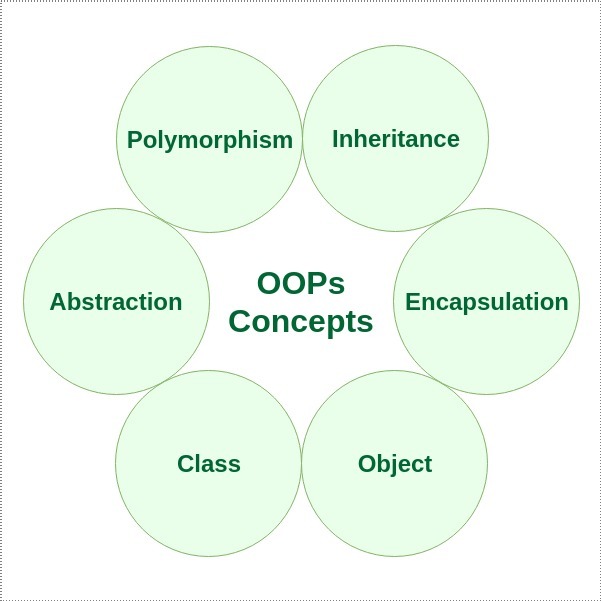
Understanding the fundamental concepts of OOP makes it easier to learn advanced programming techniques. Classes, objects, attributes, methods, and constructors form the foundation of object-oriented programming.
Class in Object-Oriented Programming
A class is a blueprint used to create objects. It defines the properties and behaviors that objects of that class can have. For example, a Student class may include attributes such as name, age, and roll number. It may also contain methods that display student information or calculate academic performance. A class does not necessarily represent a physical object. Developers can also create classes for abstract concepts such as payments, user accounts, orders, and database connections.
Object in Object-Oriented Programming
An object is an instance of a class. It contains actual data and can use the methods defined by its class. For example, if Student is a class, an individual student named Ali can be represented as an object. Another student named Sara can be represented by a separate object created from the same class. Each object can have different attribute values while sharing the structure and behavior defined by the class.
Attributes and Properties in OOP
Attributes are variables associated with an object or class. They store information about the object. In a student management application, attributes might include a student’s name, age, email address, and academic grade. In a banking application, attributes could include an account number, account holder’s name, and account balance. Attributes allow objects to maintain their own data and represent different states within an application.
Methods in Object-Oriented Programming
Methods are functions defined inside a class. They describe the actions an object can perform or provide ways to interact with its data. For example, a bank account class may include methods for depositing money, withdrawing money, and checking the current balance. Methods help keep related functionality together, making the program easier to understand, test, and maintain.
Constructor in Object-Oriented Programming
A constructor is a special method or mechanism used to initialize a new object. It can assign initial values to the object’s attributes when the object is created. For example, when a developer creates a student object, the constructor can automatically set the student’s name and age. This reduces the need to initialize each property separately after creating the object. In Python, the __init__() method is commonly used for initialization, while in Java, constructors use the class name and can accept parameters.
The Four Main Principles of Object-Oriented Programming
The four major principles of OOP are encapsulation, abstraction, inheritance, and polymorphism. These principles help developers create software that is easier to organize, extend, and maintain.
Encapsulation in OOP
Encapsulation is the process of combining data and the methods that operate on it within a class while controlling how that data can be accessed or modified.
For example, a bank account object contains an account balance. Instead of allowing other parts of the application to change the balance freely, the class can provide deposit and withdrawal methods that validate transactions.This approach helps protect an object’s internal state and prevents invalid operations. Encapsulation is useful in applications that manage important information, including banking systems, customer accounts, inventory software, and employee management platforms.
Abstraction in OOP
Abstraction means showing essential functionality while hiding unnecessary implementation details.Consider using an ATM. A customer can withdraw money by following simple instructions without understanding the internal software, database operations, or communication with the bank.
Similarly, a developer can use a method such as withdraw() without needing to know every internal step used to process the transaction. Abstraction reduces complexity and allows programmers to focus on what an object does rather than every detail of how it works.
Inheritance in Object-Oriented Programming
Inheritance allows one class to acquire properties and methods from another class. The existing class is often called the parent or base class, while the new class is called the child or derived class.For example, a general Vehicle class might contain properties such as brand and speed. A Car class can inherit those properties and introduce additional features, such as the number of doors.
Inheritance encourages code reuse and can help developers create logical relationships between related classes. However, inheritance should be used carefully because unnecessary or complicated class relationships can make software harder to maintain.
Polymorphism in OOP
Polymorphism means that different objects can respond to the same method or interface in different ways.
For example, a Dog object and a Cat object may both have a method called sound(). When the method is called, the dog produces a bark while the cat produces a meow.
The calling code can use the same method name without needing to know the exact implementation for every object. Polymorphism supports flexible software design, allowing developers to add new object types with fewer changes to existing code.
Object-Oriented Programming Example in Python
Python is a popular programming language for learning OOP because its syntax is relatively easy to understand. The following example demonstrates how a class, objects, attributes, and methods work together.
| Code Element | Meaning | Example |
|---|---|---|
| class Student: | Creates a class named Student | Student is the blueprint |
| __init__(self, name, age) | Constructor that initializes a new object | Sets name and age |
| self.name = name | Stores the student’s name | Ali or Sara |
| self.age = age | Stores the student’s age | 20 or 22 |
| display_info() | Defines a method to display student information | Shows name and age |
| student1 = Student(“Ali”, 20) | Creates the first Student object | Name: Ali, Age: 20 |
| student2 = Student(“Sara”, 22) | Creates the second Student object | Name: Sara, Age: 22 |
| student1.display_info() | Calls the method for the first object | Displays Ali’s information |
| student2.display_info() | Calls the method for the second object | Displays Sara’s information |
| self | Refers to the current object | student1 or student2 |
Although both objects come from the same class, they maintain their own data. This demonstrates how object-oriented programming can represent multiple entities using a reusable structure.
Types of Inheritance in Object-Oriented Programming
Inheritance can be organized into several types, depending on how classes are related. These structures are supported differently across programming languages.
Single Inheritance
Single inheritance occurs when one child class inherits from one parent class. For example, a Car class may inherit common properties and methods from a Vehicle class. This approach allows a child class to reuse existing functionality while introducing its own specialized features.
Multiple Inheritance
Multiple inheritance occurs when a class inherits from more than one parent class. For example, a class may combine behaviors from separate classes representing printing and scanning. Python supports multiple inheritance, while Java uses interfaces rather than allowing a class to inherit from multiple classes.
Multilevel Inheritance
Multilevel inheritance occurs when a class inherits from another child class, creating a chain of relationships. For example, Vehicle may be the parent of Car, and ElectricCar may inherit from Car. This structure allows specialized classes to build upon existing functionality.
Hierarchical Inheritance
Hierarchical inheritance occurs when multiple child classes inherit from the same parent class. For example, Car, Truck, and Motorcycle may all inherit common features from a Vehicle class. This allows different vehicle types to share common functionality while maintaining their individual characteristics.
Hybrid Inheritance
Hybrid inheritance combines two or more inheritance patterns. It can be useful in complex systems but may introduce additional design challenges, especially when multiple inheritance paths overlap. Developers should use this structure carefully to avoid unnecessary complexity.
Object-Oriented Programming vs Procedural Programming
Object-oriented programming and procedural programming are two different approaches to organizing software. Both can be useful, depending on the project’s requirements.
Main Difference Between OOP and Procedural Programming
Object-oriented programming organizes software around classes and objects, while procedural programming focuses on procedures and functions that perform specific tasks. In OOP, data and related behavior are often grouped together within objects. In procedural programming, data is commonly passed between functions as needed.
OOP encourages code reuse through classes, composition, and inheritance, whereas procedural programming commonly uses reusable functions and modules. Object-oriented programming is frequently used in large applications and simulations, while procedural programming can be suitable for scripts and task-focused software.
OOP can be useful when a program contains many related entities and behaviors. Procedural programming can be simpler for small scripts, straightforward calculations, or tasks that do not require complex object relationships. Neither approach is universally better because the right choice depends on the project’s complexity, requirements, and maintenance needs.
Advantages of Object-Oriented Programming
Object-oriented programming offers several benefits that make it useful for developing and maintaining software applications.
Code Reusability in OOP
Classes, inheritance, and composition allow developers to reuse existing functionality rather than repeatedly writing similar code. This can reduce duplication, save development time, and make software easier to update when shared functionality changes.
Improved Code Organization
OOP groups related data and behavior into classes. This structure makes it easier to identify where specific functionality belongs, especially in large projects. Well-organized classes help developers understand how different parts of an application work together.
Easier Software Maintenance
When classes have clear responsibilities, developers can often update one part of a program without changing every other component. Well-designed object-oriented systems are easier to test, debug, and extend. This can be particularly helpful when applications receive regular updates.
Better Data Management
Encapsulation provides controlled access to object data. Methods can validate input and maintain rules, helping prevent invalid states within an application. This approach is useful when software handles important records or transactions.
Scalability and Flexibility
Object-oriented designs can support new features through additional classes, interfaces, or implementations. Polymorphism can make it easier to extend a system without rewriting all existing code. This flexibility can be valuable as applications grow and requirements change.
Disadvantages of Object-Oriented Programming
Although OOP has many benefits, it also has limitations that developers should understand before using it.
Increased Complexity for Beginners
Learning classes, objects, inheritance, abstraction, and polymorphism can be challenging for people who are new to programming. Beginners may find simple procedural code easier to understand initially. Building small projects can help make these concepts clearer.
More Code for Simple Tasks
Creating classes and objects can introduce unnecessary overhead when a program only needs to perform a few straightforward operations. In such situations, a simple function or short script may be easier to write and maintain.
Memory and Performance Overhead
Depending on the language and implementation, object creation and method dispatch may introduce additional memory usage or runtime overhead. The impact varies and is often insignificant in ordinary applications, but it can matter in performance-sensitive software.
Poor Design Can Become Difficult to Maintain
Deep inheritance hierarchies and tightly connected classes can make changes complicated. OOP does not automatically produce clean code; good design decisions are still necessary. Developers should keep class responsibilities clear and avoid unnecessary relationships.
Popular Programming Languages That Support OOP
Many widely used programming languages support object-oriented programming, although they differ in syntax, features, and how strongly they emphasize objects.
Python for Object-Oriented Programming
Python supports classes, inheritance, encapsulation conventions, and polymorphism. Its readable syntax makes it a popular option for learning OOP, automation, data analysis, and web development. Developers can also combine object-oriented programming with procedural and functional approaches.
Java for Object-Oriented Programming
Java is widely used in enterprise software, backend systems, and Android development. It provides class-based object-oriented features and interfaces for defining shared behavior. Its structured approach makes it useful for building large applications with clearly defined components.
C++ for Object-Oriented Programming
C++ supports object-oriented programming alongside procedural and generic programming. It is used in game development, system software, and applications that require detailed control over performance. Developers can use classes, inheritance, and polymorphism to organize complex programs.
C# for Object-Oriented Programming
C# is a modern, object-oriented language commonly used for .NET applications, enterprise software, and game development with Unity. It provides classes, interfaces, inheritance, and other features that help developers create structured applications.
JavaScript for Object-Oriented Programming
JavaScript supports object-oriented programming through objects, prototypes, and class syntax. It is widely used for interactive websites, web applications, and server-side development. Developers can use object-oriented techniques alongside other programming styles.
Real-World Applications of Object-Oriented Programming
OOP is used across many industries because it helps developers represent complex systems through interacting components.
OOP in Web Development
Web applications can use objects to represent users, products, shopping carts, payments, and orders. Object-oriented programming can help organize backend logic and business rules into reusable components. It can also make large applications easier to maintain as new features are introduced.
OOP in Mobile App Development
Mobile applications often use objects to represent screens, users, notifications, settings, and application data. Object-oriented design can help organize features and support ongoing development. Developers can separate responsibilities to make the application easier to test and update.
OOP in Game Development
Games frequently contain objects such as players, enemies, weapons, vehicles, and game environments. Each object can have its own properties and behaviors, making OOP useful for organizing gameplay systems. Inheritance and polymorphism can also help manage different character types and interactive elements.
OOP in Banking and Financial Software
Banking applications can represent accounts, transactions, customers, and payment methods as objects. Methods can enforce business rules and help manage transaction-related operations. Encapsulation can also help control access to account information and reduce unintended changes.
OOP in Business and Enterprise Applications
Large business systems often manage employees, inventory, invoices, orders, and customer records. OOP can help separate responsibilities and organize these interconnected parts of an application. This structure can make it easier for development teams to maintain and extend business software.
Best Practices for Learning Object-Oriented Programming
Start With Classes and Objects
Beginners can learn OOP more effectively by understanding its basic concepts before moving to advanced design techniques. Start by learning one programming language, such as Python or Java, and practice creating simple classes and objects. Build small projects such as a student management system, library application, or bank account program to understand how attributes and methods work together.
Practice the Four Principles of OOP
Learn encapsulation, abstraction, inheritance, and polymorphism through practical examples. Focus on implementing each principle separately before combining them in larger projects. This approach helps you understand how each concept contributes to software design.
Write Clean and Reusable Code
Focus on writing classes with clear responsibilities, meaningful names, and methods that perform specific tasks. Avoid creating overly complicated inheritance structures. Use composition when one object needs to work with another without necessarily inheriting from it.
Build Practical Programming Projects
As you gain experience, explore inheritance, composition, interfaces, and common design patterns. Practice reading existing code and improving your own projects rather than focusing only on memorizing definitions. Real-world practice helps you understand when object-oriented programming is useful and when a simpler approach may be more appropriate.
Frequently Asked Questions
What Is Object-Oriented Programming in Simple Words?
Object-oriented programming is a way of writing software by organizing code into objects that contain data and methods. It helps developers represent real-world entities and manage related functionality in a structured way.
What Are the Four Main Principles of OOP?
The four main principles are encapsulation, abstraction, inheritance, and polymorphism. They help developers organize code, manage complexity, reuse functionality, and create flexible software.
What Is the Difference Between a Class and an Object?
A class is a blueprint that defines attributes and methods, while an object is an individual instance of that class. Multiple objects can be created from one class, each with its own data.
Is Python an Object-Oriented Programming Language?
Yes. Python supports object-oriented programming through classes, objects, inheritance, and polymorphism. It also supports procedural and functional programming approaches.
Why Is Object-Oriented Programming Important?
OOP is important because it can improve code organization, encourage reuse, support maintenance, and help developers manage complex applications. Its usefulness depends on how well the design matches the project’s needs.
Is OOP Difficult to Learn?
OOP can be challenging at first because it introduces several connected concepts. However, beginners can learn it gradually by practicing classes, objects, attributes, and methods before moving to more advanced principles.
Where Is Object-Oriented Programming Used?
OOP is used in web applications, mobile apps, video games, banking systems, enterprise software, and many other types of applications. It is particularly useful when software contains multiple related components that need to interact.
Conclusion
Object-Oriented Programming is an important programming paradigm that helps developers build structured, reusable, and maintainable software. By organizing code around classes and objects, programmers can represent real-world entities, group related data and behaviors, and manage complex applications more effectively.
Understanding classes, objects, attributes, methods, and constructors provides the foundation for learning OOP. The four main principles—encapsulation, abstraction, inheritance, and polymorphism—explain how object-oriented systems can protect data, reduce complexity, reuse functionality, and support flexible designs.
Whether you are learning Python, Java, C++, C#, or JavaScript, practicing object-oriented programming through small projects can strengthen your programming skills. With consistent practice and thoughtful design, OOP can become a valuable tool for developing reliable and maintainable software.
